
FLIPBOOK: CREATION MYTH OF JAPAN
FLIPBOOK: CREATION MYTH OF JAPAN


Click the cover page image below to enjoy reading!
Students read a bilingual flipbook, a simplified version of the folktale Ikkyu-san, and discuss and reflect on the story and themes by answering the questions provided below.
いっきゅうさん is a clever and somewhat mischievous young boy who is in training to become a Zen monk. There is a series of stories which document his adventures as he outwits the adults he encounters. In this particular story, いっきゅうさん catches an old priest lying about the sweets he is eating.
Explore our other Nihongo flipbooks! → https://classroomresources.sydney.jpf.go.jp/resources/nihongo-flipbooks/
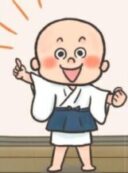 いっきゅうさん is the nickname of Ikkyū Sōjun (一休宗純 1394-1481), a Zen monk from the Muromachi period. He has been featured in Japanese folktales and anime and has long been beloved by children in Japan. He appeared to be a folk hero who is mischievous and always outsmarting the head priest of the temple and even the Shogun.
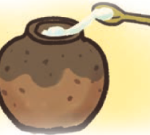 みずあめ is a sweet, sticky traditional candy. It tastes sweet and looks similar to honey. It used to be popular among children, who would stretch it, twirl it around sticks, and eat it like chewy taffy.
The wit of いっきゅうさん was legendary and he is the subject of many とんちばなし. These stories flourished during the Edo Period, about 200 years after his death. Some were confused with stories of other monks and some were made up, but they all reflect his wit and humanity. The story of this flipbook introduces a famous とんちばなし in which the young いっきゅうさん outwits the greedy おしょうさん (old priest of the temple). This story is also the subject of a famous Kyogen (狂言), a performance presented between Noh plays, called ‘Busu’ (附子).
Further research ideas:
1. Arranging the Story
Download and print the story for students to read.
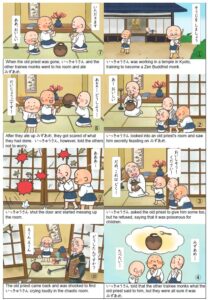 Variation 1: Arrange the story in order
1. Print out the page and cut the story panels apart.
2. Ask students to read them and arrange the story in order.
3. For more advanced students, separate the English text from the pictures.
Variation 2: Match text and images
1. Give students the English story strips and the story images separately.
2. Ask students to match each text strip to the correct picture.
2. Filling in the Speech Bubbles
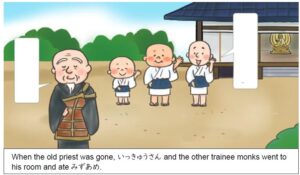
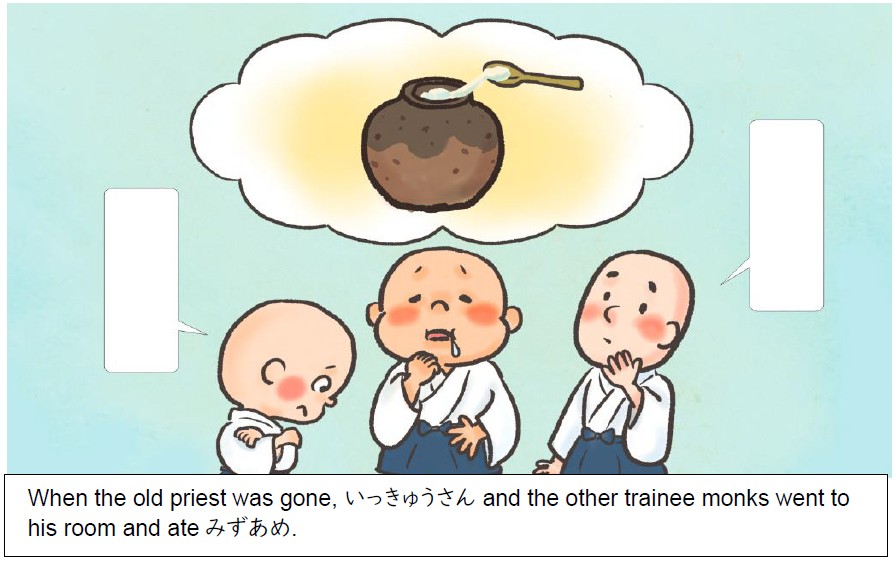
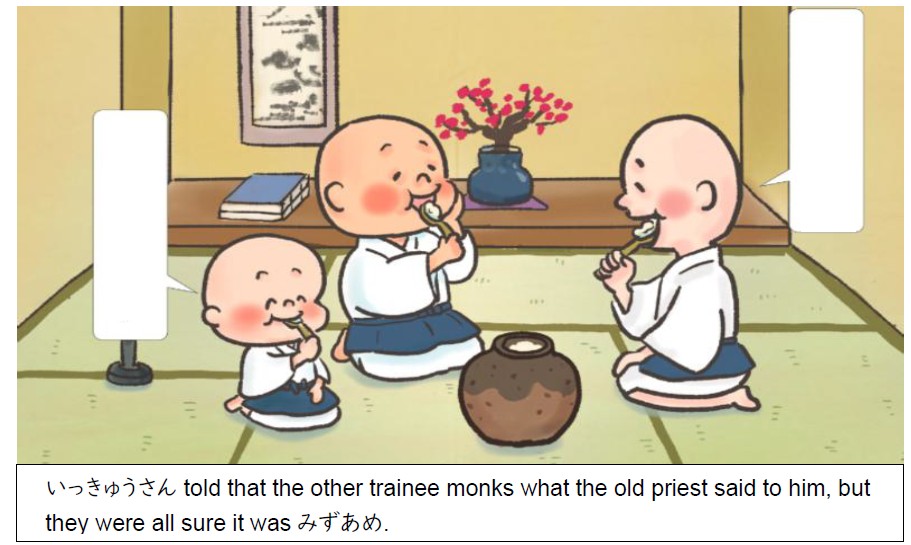
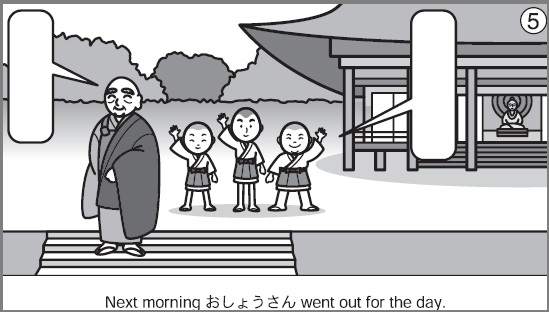
Give students some pictures from the story with blank speech bubbles and ask them to write suitable dialogue in the bubble. Students can write freely or may be given the expressions as below. Click the pictures to download the worksheet.
「いってらっしゃい」「いってきます」「 みずあめ」「たべたい」「いただきます」「ああ、おいしい」
3.Roleplay
Students work cooperatively in groups or as a class to prepare and perform the skit of いっきゅうさん for their classmates or at a school event.
*Please note that the following skit is a different version, so the language and details are slightly different from the flipbook introduced above. Students’ handout for doing the roleplay can be downloaded from PLAY Ikkyu san
Wikipedia information on Ikkyu-san.
http://en.wikipedia.org/wiki/Ikkyu
A very brief background to Zen Buddhism, and an interesting section on how to perform “zazen”.
https://www.britannica.com/topic/zazen
More information on Buddhism and Shinto.
www.japan-guide.com/e/e2055.html
This resource was revised and updated by Tomomi Chiba and Himiko Negishi-Wood (July 2026).
Illustration by amachakoubou (https://amachakoubou.com/)
FLIPBOOK: CREATION MYTH OF JAPAN
BOARD GAME: Travel Around Japan
Students explore spring in Japan through a flipbook and related activities.
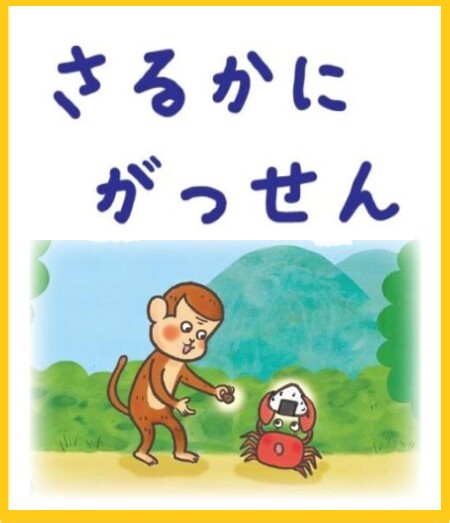
FLIPBOOK: Sarukani Gassen (The battle of the crab and the monkey)