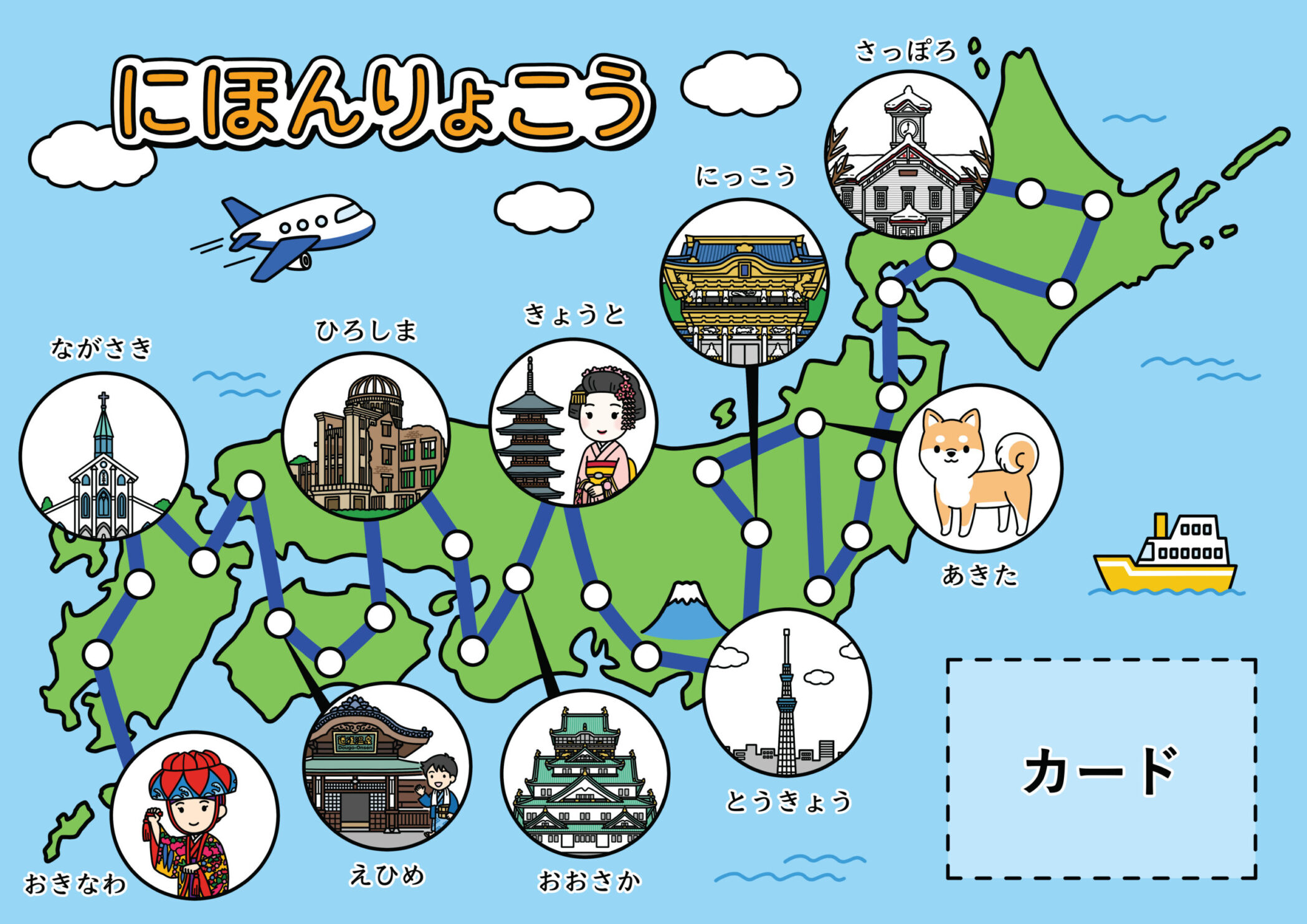
BOARD GAME: Travel Around Japan
BOARD GAME: Travel Around Japan


 Learn how to recognise the structure of kanji and become familiar with the concept of identifying and looking up a kanji compound by looking at its radical.
Please see the Handout for students for the tasks introduced below.
Kanji can be divided into four main groups according to how they are formed: 象形文字(pictographs), 指示文字(sign characters), 会意文字(kanji with combinations of meanings), and 形声文字(kanji with combinations of meaning and sound). 形声文字 are kanji made up of two or more components, one representing sound and another representing meaning, and they make up the majority of kanji in daily use. The components which give the meaning are called部首), radicals. Although 形声文字may look complicated, once they are divided into radicals and other components, they become simple. Radicals are classified into seven types, based on where they appear.

Note: The radical 月 originates from two different kanji.
eg. 脳 (brain) 肺 (lung) 胴 (torso) eg. 朝 (morning) 期 (term) 明るい (bright)
The left-side came from 肉, called にくづき. The right-side came from 月 (moon).

As mentioned above, radicals are classified into seven types. Some radicals have more than one position. For instance, the radical 貝 sometimes appears on the left 「販」(へん) and sometimes below 「買」(あし). The radical gives meaning to the character by hinting at the general nature of the item, so characters with the same radical share a common feature.
Find the common feature in the following groups of kanji and fill in the ‘radical’ and ‘English’ sections. (This task is useful not only for kanji learning but also for developing literacy and understanding of language as a system.)

Classify the following kanji according to their radicals


There are 2 kinds of kanji readings in Japanese:
音読みare readings that are based on historical Chinese pronunciations, and are generally used in compound words of two or more kanji. Many kanji with a common radical have identical or similar 音読み
訓読みare native Japanese readings of kanji. These readings bear no relation to the origins of the kanji, but have been ‘assigned’ to their kanji based on meaning. Note: The majority of kanji compounds use音読み , but there are some 訓読みcompounds such as 買物(and 訓読み!).
Students are given a list of kanji or a set of kanji cards and create as many compound words as possible, reading them out loud or listing the readings. Alternatively, a list of readings can be given in hiragana and students search for the appropriate kanji.

Text such as these headlines from 日豪プレス, the Australian Japanese-language newspaper, enable you to see kanji used in an authentic context, but how do you find the meaning of kanji you cannot read? A 漢英辞典(Kanji-English dictionary) enables you to do this. Here we give some information and suggestions for using a kanji dictionary.
When you look at the headlines above, you may be able to guess the meaning of some of the words from contextual clues such as katakana and numbers, but in order to find the meaning AND the reading of a kanji you need a 漢英辞典. The most common way to search for a kanji is according to the 部首(ぶしゅ) (radical). Once you have decided on the 部首, go to the 部首索引(radical index), usually found on the inside covers of the dictionary. The radicals are displayed according to number of strokes (画数). For example, in the case of 「捕」, you look for the radical 「 」, and search according to the number of strokes on the right side, in this case 7 画. If the 部首is not immediately obvious, try a number of possibilities from the components of the kanji.
To develop the ability to accurately count the number of strokes in a kanji, students may do tasks such as the following:
Rank the kanji in order of number of strokes

Once students are able to accurately count strokes, they can be given tasks using dictionaries. The following task can be done using the headlines above.
Find the meanings of:

Kanji Introduction
Origin of the characters for Kanji, Kanji word-building
Country names in Kanji
Kanji examination
Resource created by Kaori Sasaki (March 2005).
BOARD GAME: Travel Around Japan

Creating Reading Resources with Generative AI

BOARD GAME: School

Travel Related Activities